Accessibility at FinWell
We are committed to ensuring that our website is accessible to everyone, including individuals with disabilities. We strive to provide an inclusive online experience that meets the needs of all users.
Provide Accessibility FeedbackOur Accessibility Goals
FinWell is dedicated to conforming to the Web Content Accessibility Guidelines (WCAG) 2.1, level AA. These guidelines outline best practices for making web content more accessible to people with disabilities. We are continuously working to improve the accessibility of our website and ensure that it meets these standards.
- Providing alternative text for all meaningful images and non-text content.
- Ensuring sufficient color contrast between text and background colors.
- Making our website navigable using a keyboard alone.
- Using clear and concise language.
- Providing captions and transcripts for multimedia content.
- Structuring our content using semantic HTML.
- Ensuring forms are accessible to screen readers.
- Regularly testing our website for accessibility issues.
ARIA Attributes and Semantic HTML
We use ARIA (Accessible Rich Internet Applications) attributes to enhance the accessibility of dynamic content and complex user interface components. ARIA attributes provide additional information to assistive technologies, such as screen readers, about the role, state, and properties of elements on the page.
For example, we use ARIA landmarks to define the structure of our pages, making it easier for users to navigate using screen readers. We also use ARIA roles to identify interactive elements, such as buttons and menus, and ARIA states to indicate their current status (e.g., expanded or collapsed).
In addition to ARIA, we use semantic HTML elements to structure our content in a meaningful way. Semantic HTML elements, such as
<article>
,
<nav>
,
<aside>
, and
<main>
, provide context about the content they contain, making it easier for users and search engines to understand the structure of our pages.
Keyboard Navigation
Our website is designed to be fully navigable using a keyboard alone. Users can navigate through links, form fields, and other interactive elements using the Tab key. We also provide skip links to allow users to bypass repetitive content, such as navigation menus.
We ensure that all interactive elements have a clear visual focus indicator, making it easy for users to see which element is currently selected. We also avoid using keyboard traps, which can prevent users from navigating away from a particular element.
Color Contrast
We ensure that all text and background colors have sufficient contrast to meet WCAG 2.1 level AA requirements. This makes it easier for users with low vision or color blindness to read the content on our website.
We use a color contrast checker to verify that our color combinations meet the required contrast ratios. We also avoid using color alone to convey important information, as this can be problematic for users with color blindness.
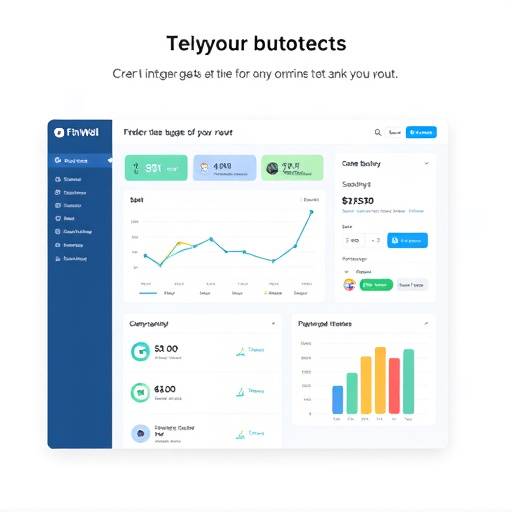
FinWell's chosen color palette – a calming blend of whites, light blues, and gentle greens – is deliberately designed to be easy on the eyes, promoting comfortable reading and navigation for all users.
Text Resizing
Users can easily resize the text on our website using their browser's built-in text resizing functionality. Our website is designed to be responsive, so the layout will adjust automatically to accommodate larger text sizes.
We avoid using fixed font sizes, which can prevent users from resizing the text. We also use relative units, such as ems and rems, to define font sizes, which allows the text to scale proportionally.
Images and Alternative Text
All images on our website have alternative text (alt text) that describes the content and function of the image. Alt text is essential for users who are unable to see the images, as it allows them to understand the information conveyed by the image.
We strive to write alt text that is accurate, concise, and informative. We avoid using generic alt text, such as "image" or "photo," and instead provide a detailed description of the image.
For decorative images that do not convey any meaningful information, we use null alt text (
alt=""
) to indicate that the image should be ignored by assistive technologies.
Forms
All forms on our website are designed to be accessible to users with disabilities. We use clear and descriptive labels for all form fields, and we associate labels with their corresponding form controls using the
<label>
element.
We provide clear error messages to help users correct any errors they make when filling out forms. We also use ARIA attributes to provide additional information to assistive technologies about the required fields and error states.
We ensure that forms can be easily navigated using a keyboard, and we avoid using CAPTCHAs that are difficult for users with disabilities to solve. If a CAPTCHA is necessary, we provide an alternative option that is accessible to all users.
Assistive Technologies
FinWell is compatible with a wide range of assistive technologies, including screen readers, screen magnifiers, and voice recognition software. We regularly test our website with these technologies to ensure that it is accessible to all users.
Some of the assistive technologies that we support include:
- JAWS (Job Access With Speech)
- NVDA (NonVisual Desktop Access)
- VoiceOver
- ZoomText
- Dragon NaturallySpeaking
Accessibility Feedback
We welcome your feedback on the accessibility of our website. If you encounter any accessibility barriers or have suggestions for how we can improve our website, please let us know.